How Many Security Cameras Does My Warehouse Need?
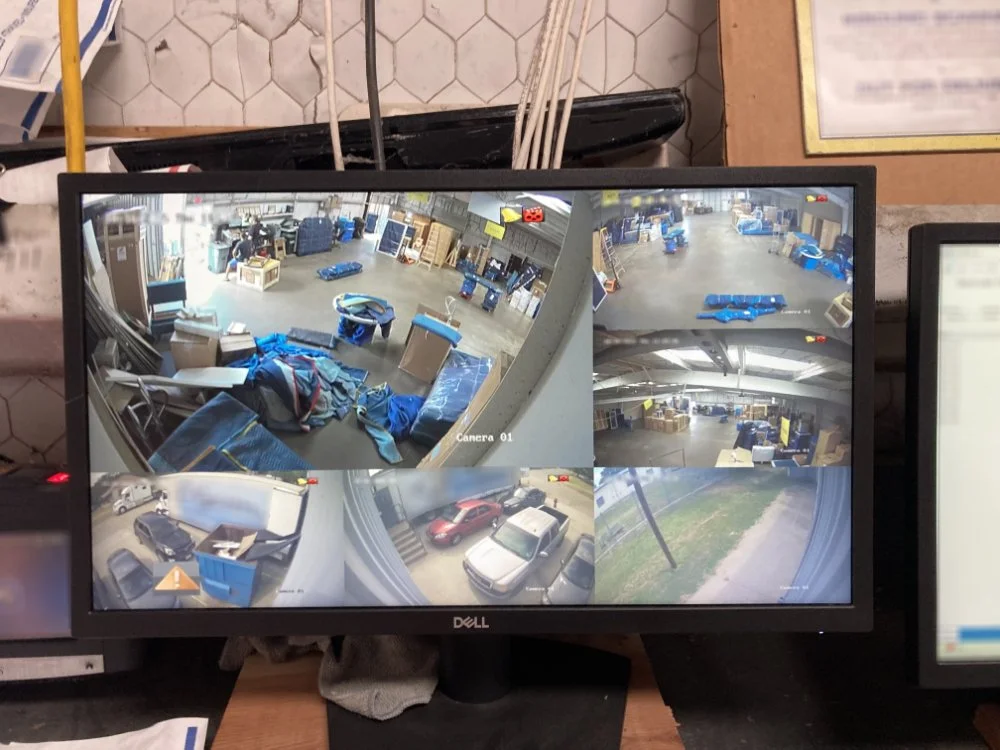
A CCTV monitor wired into a camera network covering warehouse access points and internal areas.
How Do You Scope Security Coverage for Warehouses?
The term “warehouse” covers a wide range of facilities, ranging from rooms the size of a large closet up to million-square-foot behemoths and everything in between. Sizing a warehouse security system, including the camera coverage that anchors it, is a serious task even for professionals.
Nonetheless, there are some guidelines that can help size a budget or project. These guidelines will cover most cases, but not all. Specific local or industry regulations, specific certifications, uses of different equipment, business goals, local crime environments, and many other factors can raise or lower requirements compared to these guidelines.
Once you have a generally idea of what you expect to install, Settler strongly recommends engaging professionals with specific vertical experience to assess your project. Missed requirements can easily costs thousands of dollars in warehouse environments. Just calling a lift back for an extra day can easily add $500 to $1000 in costs, but incorrect installations are only part of the problem. Shrinkage and failed audits can cost tens of thousands, while safety problems like workers comp fraud or forklift accidents can easily run into six or seven figures. It’s worth talking to someone who knows what questions to ask.
Warehouse Security Audits in Dallas-Fort Worth
For clients in our Dallas-Fort Worth service area, Settler provides free site surveys and guaranteed quotes. Contact us to get started.
Basic Warehouse Security
Basic warehouse video surveillance works for smaller warehouses and handling facilities with low-value-density inventory, limited moving equipment, and in lightly-regulated categories. For these clients, we recommend camera coverage for:
Exterior entry/exit doors
IT closet doors
Timeclocks
Lobbies or customer waiting areas
An internal and external view of all dock doors
Any safes or inventory cages
General coverage of warehouse floor and/or aisles
If budget allows, coverage of dumpsters and parking lots may be considered.
Upgraded Warehouse Security
Facilities with larger inventory areas, more-valuable inventory, separated office areas, forklifts, pallet wrappers, or production equipment will have additional needs. For these clients, we recommend a commercial security camera installation covering:
Exterior entry/exit doors
Doors between office and warehouse zones *
IT closet doors*
Any moving production or packing equipment
Forklift/PIT travel lanes
Forklift exclusion zones (for monitoring and AI violation detection)
Timeclocks
Lobbies or customer waiting areas
An internal and external view of all dock doors (likely more than one camera each, inside and outside)
Any safes or inventory cages
One/two cameras per aisle, depending on height and length
Trash handling and dumpster areas
*Consider electronic access control at these points too
High Security Warehouse Camera and Surveillance Systems
Large facilities (100,000 sq ft + ), high-volume facilities, or those with high-value, dangerous, or tightly-regulated inventory will have the most extensive industrial security systems and camera coverage requirements.
Exterior entry/exit doors, including coverage of emergency doors
Truck or vehicle gates
Guard stations
Rail sidings
Parking lots
Materials yards
Roof coverage (especially if equipped with trap doors/ladders)
Doors between office and warehouse zones *
IT closet doors*
Data storage facility interiors
Any moving production equipment
Packaging zones (strapping machines, pallet wrappers)
Receiving and pallet-breaking zones
Conveyors and sortation equipment
Forklift/PIT travel lanes
Forklift exclusion zones (for monitoring and AI violation detection)
Timeclocks (and possibly break rooms)
Tool rooms
Lobbies or customer waiting areas
An internal and external view of all dock doors (as many as two to three per door – some mix of interior, exterior, and elevated/face height)
Any safes or inventory cages (consider inclusion of interior cameras)
Multiple cameras per aisle, depending on height and length (cover multiple angles)
Trash handling, balers, compactors
Dumpster areas
*Consider electronic access control at these points too. Some very high-security facilities may also need full perimeter coverage.
Co-located Facility Security
Many warehouse facilities also house additional functions that can carry their own safety and security risks. Consider commercial surveillance camera installation for any of these facilities as well:
Dispatch or operations centers
Laboratories or research facilities (generally at entry points only to minimize risks of loss of IP)
Cash handling spaces
Showrooms or retail shop aisles
Point-of-sale (POS) locations
After-hours pickup locations (especially if self-serve)
After-hours receiving or delivery locations
Locations for service and repair (especially for vehicles and other heavy equipment)
Generators or on-site utilities (water purification, power plants, etc)
Metal detectors and other security checkpoints
Security team armories
Fuel storage
Battery charging stations (especially for large forklift/vehicle batteries)
Training or gathering spaces
Gyms or other employee recreation spaces
On-site daycares
Kitchens (especially hotlines and walk-in refrigeration units)
Dormitories (e.g. hallways)
On-site medical facilities (especially storage of medication)
Archives or libraries
Media production facilities
Company museum spaces or displays
Rental or bookable spaces (e.g. maker centers or event venues)
Exclusions
There are also locations in most warehouse and light industrial facilities that should NOT have cameras.
Respect areas where people reasonably expect privacy. Restrooms and changing areas are obvious examples, but the boundary can extend beyond your own walls. A camera pointed toward a neighboring property may inadvertently capture private spaces or activities that you have no legitimate reason to monitor. Depending on the workplace, offices, meeting rooms, and similar areas may also be considered inappropriate for routine surveillance.
Consider whether surveillance creates a security risk of its own. Not every business operation is safer when it is placed on camera. Research facilities, product-development areas, testing environments, clean rooms, and other operations targeted for industrial espionage may be better protected offline. There are options for surveilling these sites through airgapped systems or systems run on their own networks with very tight firewalls, however these should involve experts from your IT, security, and legal teams to configure. (If you are a known target for industrial espionage, you should also be very careful which equipment you or your security vendor selects.)
Check the law before installing anything. Video and audio surveillance rules vary substantially by jurisdiction, and the rules governing recording may differ depending on whether a camera is visible, whether audio is captured, and where the device is located. Texas law is the reference point for this article, but requirements elsewhere may include consent or notice obligations and restrictions on recording particular activities or groups. Some workplaces and medical settings, for example, have additional protections. Local requirements should be reviewed before equipment is purchased or installed.
Finally, make sure the camera can actually do its job. A technically functional camera is not necessarily a useful one. Poor illumination, strong backlighting, excessive distance, an unsuitable mounting angle, and physical obstructions can all make footage difficult to use. Equipment also needs to match its environment: a camera intended for ordinary indoor conditions may fail prematurely when exposed to heat, moisture, dust, vibration, or other demanding conditions.
Conclusion
As noted above, these guidelines miss a lot of important nuance. As long as the list is, it isn’t exhaustive. The specific parameters of your industry, facility, and budget all make a big difference in which solutions will be needed and how they will be installed and supported on an ongoing basis.
Hopefully these guidelines have given you a good starting point for considering coverage and sizing budget. When you’re ready to go from concept to formal plan, give us a call.
Settler Security provides free site assessments throughout the Dallas-Fort Worth service area including Dallas, Fort Worth, Carrollton, Frisco, McKinney, and surrounding communities. During your Site Assessment, we will conduct a 75+ point inspection of your facility and build a coverage map for cameras, access control, alarms and sensors.
Call us at 636-675-2309 or contact us via the form below to get started.